Why We Don't Build Fully Autonomous Agents, and Why You Shouldn't Either
Teams ask for autonomy when what they want is end-to-end automation. The two are not the same thing, and three findings explain why we build for one of them and not the other.
Give the model a set of instructions and a goal, let it reason through, and get out of the way. It is a clean abstraction, it demos beautifully, and it is what teams think we offer. We do not.
Autonomy is the word that gets attached to that ask, and it is carrying more than it should. What teams want is for the work to come back finished rather than drafted, which is an outcome. Autonomy is an architecture, and one of several that can produce it.
Declining to build the popular version of it is an awkward position to hold on conviction alone, so we ran the comparison: roughly 10,000 production runs across 150 outcome scenarios, holding the tasks and the inputs constant and changing only the architecture. Autonomous agents succeeded on 71% of tasks. Structured workflows succeeded on 82%. A structured workflow running on a weaker model still beat an autonomous agent running on the best one available (our earlier write-up of the comparison).
The market is arriving at the same place from the other direction. Gartner expects that by 2027, 40% of enterprises will demote or decommission autonomous AI agents, because governance gaps get identified only after production incidents occur. The verbs are the interesting part. Demote and decommission, not fail to deploy: these agents were live, doing real work, and got pulled back.
Three things explain that pattern.
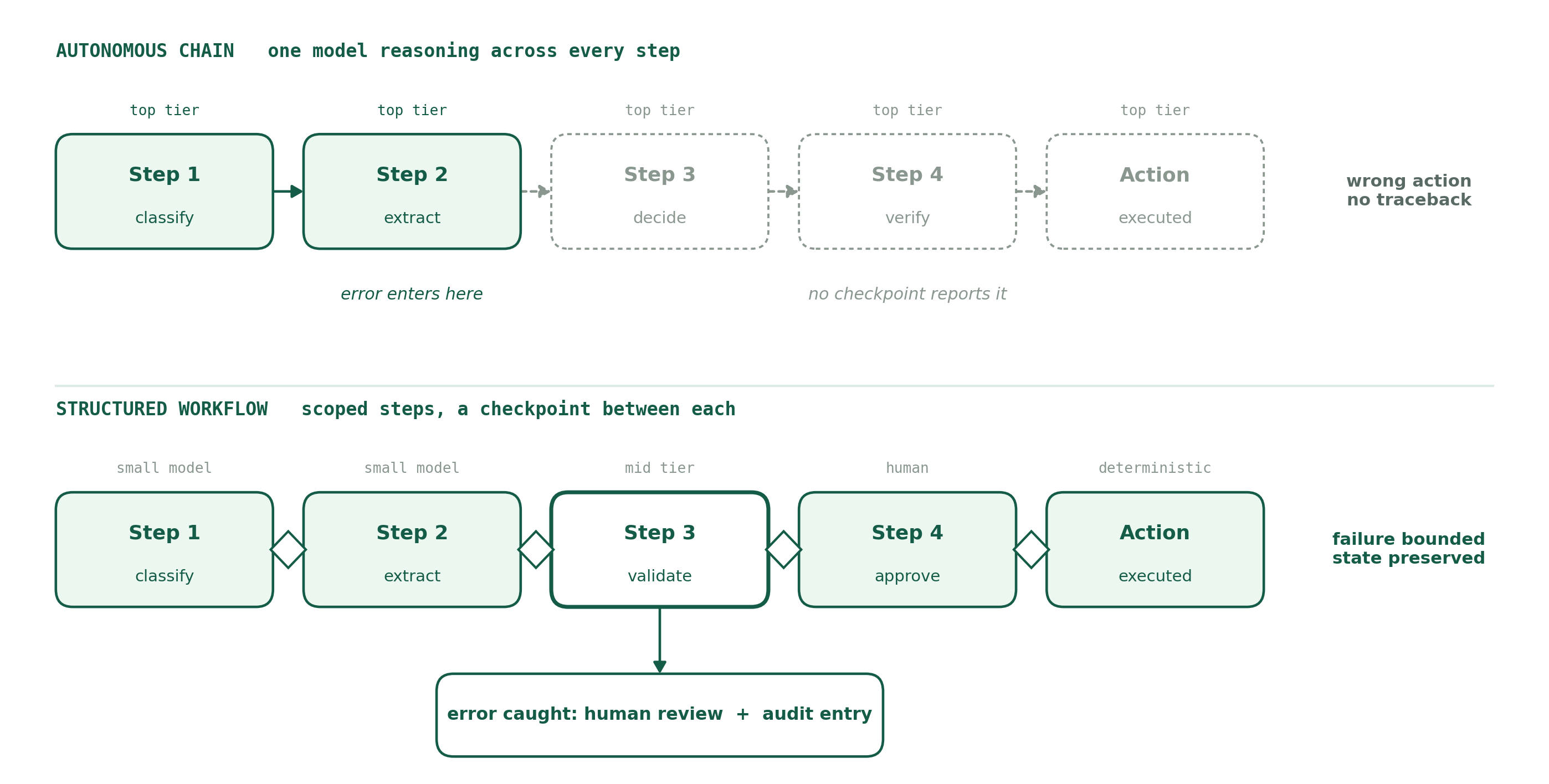
The same error in two architectures. Above, one model reasons across every step at the top tier and nothing downstream reports the mistake. Below, each step is scoped, priced to its difficulty and separated by a checkpoint, so the error is caught where it happens and leaves an audit entry behind it.
1. Capability and consistency are different things
Procurement measures capability. Production charges you for inconsistency. Almost nobody tests the second one before signing.
The clearest evidence is tau-bench, Sierra's multi-turn agent benchmark. Its real contribution was pass^k, a metric that asks what single-shot benchmarks never do: run the same task k times, does the agent succeed every time. In the 2024 run, the best agents of the day cleared fewer than 50% of tasks on one attempt and around 25% across eight. Leading models now clear 80% on a single attempt in the easier domain, but the curve has not changed shape: pass^k still decays as k rises, on every model tested. Anthropic reports pass^k in its model cards for the same reason.
The repeat number is the one an operations queue lives on. A fraud queue running 30,000 cases a month cannot use "usually correct" as a quality bar. That is not a performance level. It is a volume of incidents waiting to be discovered.
| Approach | Model tier | Coverage | Success rate |
|---|---|---|---|
| Autonomous agent | Best available | 79% | 71% |
| Structured workflow | Best available | 93% | 82% |
| Structured workflow | One tier down | 91% | 80% |
The third row is the one we found hardest to argue with. Structure was contributing more than model capability was, which puts the upgrade path most teams are planning, waiting for the next model to close the gap, on the wrong variable.
2. The failures come in a shape operations cannot absorb
Autonomous agents do not fail because they reason badly. They fail in a shape an operations team cannot work with.
In an autonomous chain, each step conditions the next. A misclassification at step two does not throw an error. It produces a slightly wrong state that propagates forward, and by the time the agent takes its final action the mistake is several reasoning steps away from the output. There is no clean traceback. The system did not fail. It drifted.
Forrester, predicting that an agentic AI deployment will cause a publicly disclosed breach, calls such events "a cascade of failures" and says blaming the people involved would be unfair. Cascade is a property of the architecture, not of the operator.
A structured workflow fails at a known step, loudly, with the state at that step preserved. You can retry it, route it to a fallback, or send it to a human, and the rest of the workflow is untouched. Aggregate rates also hide their own tail: hard cases cluster in the unusual inputs, which are exactly the inputs autonomous agents handle worst, so a 71% aggregate can sit on a much lower rate where being right matters most.
So the useful question is never the success rate. It is whether silent failure on the remainder is acceptable. Where the actions include holding funds, blocking an account and replying on the institution's behalf, it is not, and "the model decided" has never been an answer a regulator or a customer accepts.
3. Autonomy is a dial, not a destination
Autonomy was never one thing you either have or do not. Gartner classifies agents across four levels and argues that uniform governance across all four is itself a cause of failure, because organisations confuse an agent's ability to act with the scope of access it has been given.
| Level | What the agent does | Where it fits in a regulated operation |
|---|---|---|
| 1. Observe | Read-only, output to the requesting user | Retrieval and summarisation. Low stakes, light controls |
| 2. Advise | Drafts and recommendations, human executes (assistive generation) | Common and underrated. Main risk is people trusting a confident draft |
| 3. Act with approval | Writes, sends or modifies only after explicit approval | Where most consequential work belongs |
| 4. Act autonomously | Executes within guardrails, humans review exceptions and logs | Viable only for narrow, reversible, high-volume actions with circuit breakers |
The levels also pull apart the two things that get conflated. Level 2 is assistive generation, level 4 is autonomy, and the finished-work outcome most teams describe sits between them at level 3, where the system does the work and a person approves the consequential action. Most pitches for "autonomous agents" sell level 4 for work that belongs at level 3.
Level 3 has a failure mode of its own. Gartner notes that approval workflows degrade under time pressure and approval fatigue, creating a false sense of safety while widening the attack surface. Someone clearing agent proposals as fast as the queue refills is not a control, which is why we validate data against internal records before the approval step rather than reviewing output after it.
What structure costs, and what pays it back
Specifying scenarios, checkpoints and escalation paths is more work upfront than pointing a capable model at a queue. That cost is real and it lands before any of the benefit does.
What offsets it is what happens afterwards, every time the workflow runs. An autonomous chain executes every step at the best available model tier, because you cannot know in advance which step will need the reasoning, and it carries the accumulated context into each call. A structured workflow sends each step to the cheapest model that clears it and spends the premium tier only on the decisions that are genuinely hard. The third row of the table above is what makes that concrete: one tier down, structure still returned 91% coverage and 80% success, so the substitution costs nothing in outcome.
The asymmetry is in how the two costs behave. Design is paid once. Inference is paid per execution, and it is the one that scales with the queue, which is why a deterministic workflow gets cheaper to run relative to an autonomous agent as volume rises rather than more expensive. Debugging silent failures has not gotten cheaper either, and Forrester expects half of enterprise ERP vendors to launch autonomous governance modules combining explainable AI, automated audit trails and real-time compliance monitoring: the same bill arriving later and larger. McKinsey puts it from the value side, with the agent layer accounting for no more than 20% to 25% of the value in an agentic transformation and the rest sitting in operating model, data, risk and governance. The expensive part of this was never the model.
Structured workflows still send edge cases to people, by design; a workflow claiming to resolve everything without review would be a red flag, not a feature. And autonomous agents will keep improving. Better models improve the average case without eliminating the tail, and no amount of capability makes "the model decided" auditable.
Where a silent error is recoverable, autonomy is a reasonable trade. Where a wrong action holds a customer's money, it is an unpriced risk, which is roughly what 40% of enterprises are forecast to discover one incident at a time. Which is why what we built for was never model capability. It was error isolation, explicit failure modes and an audit trail.
Patched builds structured workflow AI for regulated operations: fraud and risk, customer operations and reconciliation, run as structured workflows with human review and a full audit trail. If you're weighing autonomous against structured architectures for a live workflow and want to compare notes, we're easy to find.